
What is Head Pressure?
<< prev: 2.4 Pond Rocks & Gravel: next: 3.2 What is Friction Head Pressure?>>
As we mentioned earlier, there are certain ways to design a pumping system to make the overall system more efficient. Higher efficiency means there’s less resistance for the pump to overcome to get water from the pond, through the filtration system, and out through the waterfall. Less resistance for the pump means that more water will flow out the end of the pipe for the same amount of work. The resistance a pump must overcome to pump water out the end of the pipe is called the “head pressure.” This is sort of like a car on the highway. A car will usually slow down on a steep hill, but will still use the same amount of gas even though it’s now going slower. Similarly, a pump will slow down as the head pressure increases, causing less water to be pumped. There are two main types of head pressure we’ll talk about: static head pressure and friction head pressure. The two added together make up the total head pressure we’ll use when choosing a pump. When you buy a pump, the specs will tell you how many gallons per hour will be pumped given a certain head pressure. For example, a pump may put out 2000 gph at 2’ of head, but when increased to 10’ of head, which is more realistic for a pond, the flow may reduce to 1000 gph.
Need help calculating your head pressure?
Use our Head Pressure Calculator to ease the process!
3.1 Static Head Pressure
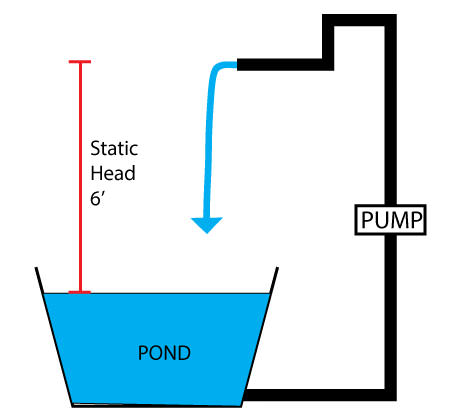
Static head pressure is the simplest form of head pressure to understand. It can be described as the elevation gain from the surface of the pond to the top of the waterfall. If the pond doesn’t have a waterfall, then it’s the elevation gain from the surface of the pond to the elevation of the water return. So if you have an upper pond and a lower pond connected by a stream, the static head pressure is the elevation gain from the surface of the lower pond to the surface of the upper pond. If you have a waterfall that falls from 6’ above the pond surface, then you will have 6’ of static head pressure for the pump to overcome. Please note that it doesn’t matter if the water intake is actually below the surface of the water; you still measure from the surface. Similarly, if the water discharge pipe is below the surface of the upper pond or waterfall, you still measure to the surface of the waterfall or wherever the water flows out back into the pond. See the drawings below for some examples.
Need help calculating your head pressure?
Use our Head Pressure Calculator to ease the process!
Need help choosing pond equipment?